
When School Anxiety Takes Over: Understanding the Nervous System Behind School Refusal
Sunday evening arrives, and you can already feel the tension building.
Your child's stomach starts hurting. Tears appear out of nowhere. Bedtime becomes a battle, and by Monday morning you're standing at the front door wondering how you're possibly going to get them into the car. By the time you reach the school parking lot, everyone is overwhelmed.
If this has become your family's weekly routine, I want you to know something important: you're not alone.
Many parents are told their child is simply anxious, being defiant, or needs firmer boundaries. But if you've watched your child completely shut down at the thought of school, you know this feels much bigger than ordinary reluctance.
At E320 Chiropractic, we believe many children struggling with school refusal aren't choosing this response. They're experiencing a nervous system that has become overwhelmed and lost its ability to adapt.
School Refusal Is Different Than Not Wanting to Go
Every child has days when they would rather stay home.
School refusal is different.
These children aren't simply trying to avoid responsibility. Their bodies are responding as though school is unsafe, even when their logical brain knows otherwise.
Once the nervous system shifts into survival mode, the thinking part of the brain has much less influence. Reasoning, consequences, rewards, and punishment rarely solve the problem because the child's body is reacting long before logic has a chance to step in.
That is why so many well-intentioned parenting strategies leave families feeling frustrated and discouraged.
When the Nervous System Gets Stuck in Survival Mode
The autonomic nervous system has one primary job: helping us respond appropriately to the world around us.
Part of that system prepares us to respond to danger. Another part helps us rest, recover, regulate emotions, and adapt to everyday life.
Healthy nervous systems move smoothly between those two states.
But for some children, the nervous system becomes stuck in chronic fight-or-flight. Instead of recognizing school as a safe place, their body responds as though it is facing a genuine threat.
The stomach ache, racing heart, nausea, panic, tears, and inability to walk into the building are not signs of manipulation.
They are signs of a nervous system that no longer feels safe.
Why the Vagus Nerve Matters
One of the most important players in this conversation is the vagus nerve.
The vagus nerve helps regulate digestion, heart rate, breathing, emotional regulation, and the body's ability to feel calm and socially connected. When it is functioning well, children are better able to adapt to change, recover from stress, and move through challenging situations.
When the nervous system becomes dysregulated, vagal function often decreases. As a result, the body becomes more reactive, digestion becomes more sensitive, and everyday stressors begin to feel much bigger than they actually are.
This is one reason so many children with school anxiety also complain of stomach aches, nausea, headaches, or other physical symptoms before school. Those symptoms are real. They are simply being driven by a nervous system that is under chronic stress.
School Anxiety Often Starts Long Before School
Parents are often surprised to learn that school refusal rarely begins with school itself.
More often, it is the result of what we call the Perfect Storm—a series of stressors that gradually shape how a child's nervous system responds to the world.
For some children, those stressors begin during pregnancy. Others experience additional challenges during birth or early infancy. Sleep struggles, frequent illness, antibiotics, sensory overload, emotional stress, and the demands of childhood continue adding layers over time.
Eventually, the nervous system reaches a point where it loses flexibility.
School simply becomes the place where that underlying stress finally shows itself.
Looking Beyond the Symptoms
At E320 Chiropractic, we don't simply ask why a child is refusing school.
We ask why their nervous system is struggling to adapt.
Using Neurological INSiGHT Scans, we evaluate how the autonomic nervous system is functioning and how well it is responding to stress. These scans allow us to objectively measure nervous system patterns instead of relying only on symptoms or observation.
The Heart Rate Variability (HRV) Scan evaluates how adaptable the nervous system is and how easily it moves between stress and recovery. The NeuroSpinal EMG measures patterns of neurological tension and energy output, helping us understand how hard the nervous system is working throughout the day. The NeuroThermal Scan evaluates autonomic nervous system function and identifies areas where chronic stress may be affecting overall regulation.
Together, these scans help us better understand what may be driving your child's struggles beneath the surface.
Supporting the Nervous System From the Foundation Up
Once we understand how the nervous system is functioning, we can create a care plan designed to support healthier regulation and adaptability.
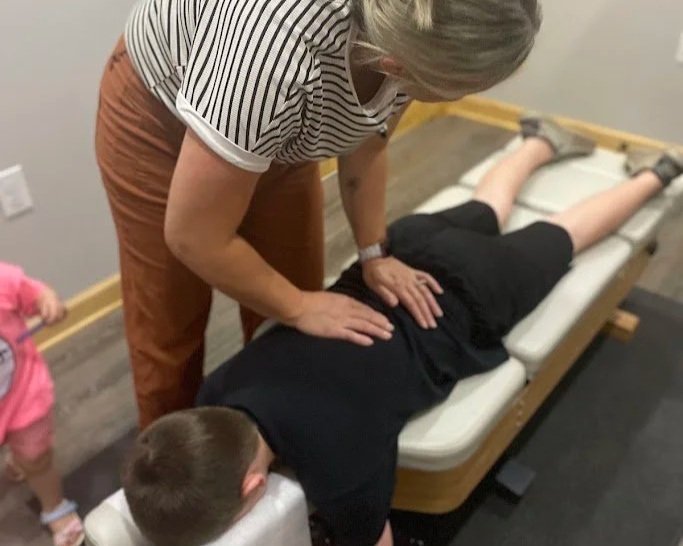
Neurologically-focused chiropractic care is designed to reduce nervous system stress and improve communication throughout the body. As the nervous system becomes more regulated, many families begin noticing improvements that extend well beyond school mornings.
Children often sleep more soundly, digest more comfortably, recover from stress more easily, and become more emotionally flexible. Over time, many parents notice that situations which once triggered panic no longer feel quite so overwhelming.
Your Child Deserves More Than Another Label
If your child is struggling with school refusal or severe school anxiety, please hear this:
They are not broken.
They are not trying to make your life harder.
And you have not failed as a parent.
Sometimes the missing piece isn't another behavior strategy or another label. Sometimes it's understanding how the nervous system is functioning and giving it the support it needs to adapt again.
At E320 Chiropractic, we're passionate about helping families uncover those answers. If your child is struggling with school anxiety, we'd love to help you better understand what their nervous system may be telling us and whether neurologically-focused care could be part of their path forward.
Because every child deserves the opportunity to feel safe, confident, and ready to engage with the world around them.