
The Test That Won't Come Back "Normal": Looking Beyond Bloodwork for Answers
One of the hardest things a parent can hear is, "Everything looks normal."
The bloodwork is normal. The MRI is normal. The EEG is normal. Yet your child is still struggling with sleep, digestion, behavior, sensory challenges, anxiety, focus, chronic illness, or developmental concerns.
If you've found yourself thinking, There has to be something we're missing, you're not alone.
At E320 Chiropractic, many families tell us they've spent months—or even years—searching for answers. They've seen specialists, tried therapies, changed diets, added supplements, and done everything they know to do. While those approaches can absolutely play an important role, many parents are surprised to learn that no one has ever evaluated the one system that coordinates all of them: the nervous system.
Why Traditional Testing Doesn't Always Find the Answer
Modern medicine does an incredible job identifying disease, injury, infection, and structural problems. Bloodwork, imaging, and neurological testing are all important tools when those conditions are suspected.
But those tests answer a very specific question:
Is something damaged or diseased?
They do not necessarily answer another question that is just as important:
How well is your child's nervous system actually functioning?
Those are two very different conversations.
A child can have completely normal lab work while still struggling with nervous system dysregulation. The nervous system may be under chronic stress, having difficulty adapting, or struggling to communicate efficiently with the rest of the body long before disease ever develops.
That is the gap we are looking to fill.
Why the Nervous System Matters
The nervous system is the body's master communication network. Every organ, every tissue, and every system relies on it to know what to do and when to do it. When communication is clear, the body is able to regulate, heal, adapt, and grow the way it was designed. When communication becomes disrupted by chronic stress, the effects can show up almost anywhere.
The autonomic nervous system regulates all the functions we never have to consciously think about—sleep, digestion, heart rate, breathing, hormone regulation, immune function, emotional regulation, and stress adaptation.
When the nervous system becomes overwhelmed and stuck in patterns of chronic stress, that communication becomes less efficient. We often refer to this as nervous system dysregulation, or dysautonomia. Instead of adapting smoothly to everyday stress, the body begins compensating, and those compensation patterns can show up as symptoms across multiple systems.
This is why we often remind families that the nervous system is the foundation. If the system coordinating every other system is struggling, it makes sense that symptoms can appear in many different places at once.
Why We Use INSiGHT Scans
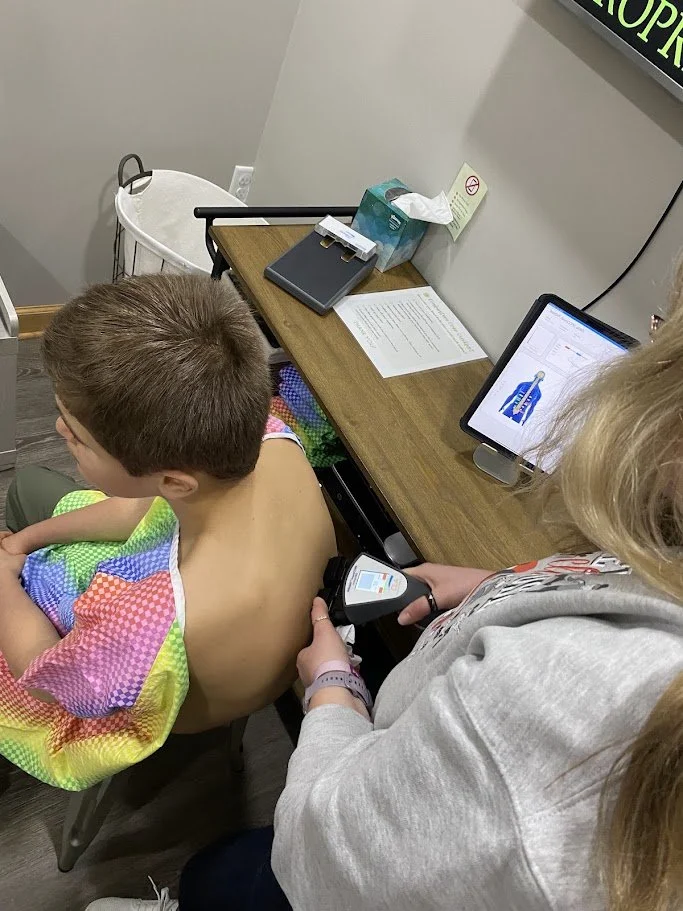
This is why every new practice member at E320 Chiropractic begins with Neurological INSiGHT Scans.
Rather than guessing based only on symptoms, these scans allow us to objectively evaluate how the nervous system is functioning. Even more importantly, we repeat the scans throughout care so families can actually see how the nervous system is changing over time.
We are not simply looking for another diagnosis. We are looking for patterns of stress, imbalance, adaptability, and regulation that help explain why symptoms may be occurring in the first place.
Many of the children we see are dealing with concerns like:
Reflux and digestive struggles
Colic or constipation
Recurring ear infections
Sensory processing challenges
ADHD or attention difficulties
Anxiety and emotional regulation
Sleep struggles
Developmental concerns
Hormonal or immune challenges
While these symptoms may seem unrelated, they often share one common denominator: the nervous system.
The Three INSiGHT Scans
Our INSiGHT Scans work together to provide a more complete picture of how your child's nervous system is functioning.
NeuroThermal Scan
The NeuroThermal Scan evaluates how the autonomic nervous system is functioning. It helps us identify patterns of stress that may be affecting digestion, immune function, sleep, hormone regulation, and overall adaptability.
This scan is gentle enough for newborns and provides valuable insight into how well your child's nervous system is regulating the automatic functions that keep the body healthy.
NeuroSpinal EMG Scan
The NeuroSpinal EMG measures how much stress, tension, and energy your child's nervous system is using. It helps us identify whether the nervous system is organized and adaptable or working much harder than it should simply to keep your child functioning throughout the day.
This scan often helps us better understand patterns we see in children with sensory processing challenges, ADHD, autism, anxiety, developmental delays, or chronic stress.
Sometimes we see what we refer to as a "Raging Bull" pattern, where the nervous system is operating in constant overdrive. Other children show a "Drunken Bull" pattern, reflecting poor neurological organization, reduced coordination, and difficulty adapting. Many children demonstrate a combination of both.
These patterns help explain why a child may seem constantly overwhelmed, exhausted, or unable to regulate despite everyone's best efforts.
Heart Rate Variability (HRV)
The Heart Rate Variability Scan evaluates how adaptable the autonomic nervous system is.
Rather than simply measuring heart rate, HRV tells us how well the body shifts between stress and recovery. Children with low adaptability often struggle with transitions, emotional regulation, frequent illness, anxiety, or recovering from everyday stressors.
As the nervous system becomes healthier and more adaptable, HRV often improves as well, giving us another objective way to measure progress throughout care.
Looking Beyond the Symptoms
One of the things we appreciate most about INSiGHT Scans is that they help move families beyond guessing.
Instead of wondering why one child has digestive issues, another has sensory challenges, and another struggles with focus, we can begin looking at how well the nervous system is coordinating all of those functions together.
The scans do not replace your pediatrician or other providers. They also do not replace therapies that your child may benefit from. Instead, they often help explain why those therapies may not be progressing as expected.
When the nervous system becomes more organized, adaptable, and regulated, many families find that other interventions begin working more effectively because the foundation underneath them has improved.
You Deserve More Than "Everything Looks Normal"
If your parental instinct keeps telling you something is off, trust it.
Many of the children we care for had normal lab work, normal imaging, and normal evaluations before their families ever walked through our doors. That does not mean their symptoms were not real. It simply means no one had evaluated the system coordinating everything else.
At E320 Chiropractic, our goal is not simply to label symptoms. We want to help families understand how their child's nervous system is functioning so they can make informed decisions and support healing from the foundation up.
Because sometimes the answers you've been searching for are not found in another diagnosis.
Sometimes they begin by finally looking in the right place.